Pages

Monday, October 17, 2011

Mostar, Bosnia

We read in Rick Steve's Slovenia and Croatia, that Bosnia was only a short 2 hour drive from Dubrovnik.  Instead of taking one of the many tours offered to Bosnia by bus, we decided to rent a car so we'd be on our own schedule, but we wanted to learn about the city, so we called Alma Elezovic (aelezovic@gmail.com).  Rick Steve recommended Alma in his book, and after hearing the story of Mostar from her eyes, I realized that most, if not all, of the information in Rick's book about Mostar was taken directly from her, almost word for word.

Renting a car in Croatia is one of the easiest rental car experiences we've ever had.  The concierge at the Bellvue had an arrangement with various rental car companies.  The morning we decided to go to Bosnia we went to the concierge and asked if they could get a car for us.  As we were having breakfast, we were told the car was waiting outside. We paid a total of about $50 in cash for the day, and that was that.  No questions about elective insurance, and that feeling of uneasiness when you opt out, no credit card swipe for incidentals, no nothing. 

On the way to Mostar from Dubrovnik, there is a stretch of about 15km that turns from Croatia to Bosnia, then back to Croatia, before entering Bosnia once again (which implies having to wait in line and show your passport before crossing each border).  The town of Neum is in this area, and coincidentally, this stretch of land happens to be the only coastal part of Bosnia.  The history behind this 15km area is really interesting.  In 1399, the Dubrovnik Republic (Ragusa) acquired Neum from Zahumlje. In 1699, Dubrovnik relinquished control of the region to the Ottoman Empire at the Treaty of Karlowitz following the Great Turkish War. It gave the Turkish army access to the sea, and in exchange, the Ottomans agreed to protect Dubrovnik from the Republic of Venice, which was at that time conquering the coastal regions of Croatia. Neum was under Ottoman control for 179 years until 1878, when Bosnia and Herzegovina came under Austro-Hungarian rule. Neum then joined the Kingdom of Serbs, Croats and Slovenes (Yugoslavia) as a part of a number entities between 1919 and 1992 (when Bosnia and Herzegovina declared independence).  
Mostar, Bosnia

When we finally arrived in Mostar, Alma was already waiting for us. What made Alma an incredibly interesting tour guide is the fact that she is a Bosniak (Muslim) that lived through the war in Bosnia, i.e. she didn't leave like much of the population did.  After having just recently heard the perspective of a Croatian soldier, hearing Alma's point of view really provided us with a full picture of the war from two opposing sides.  Throughout the tour, Alma told us many of her daily struggles during the war. She lived without electricity or running water for a year and food was rationed as the Bosnian government saw fit.  She told us, "you can't tell now, but I ate so little back then, I looked like a super model".  For that one year period, she could not go out of her apartment from sun up to sun down for fear of being targeted by snipers that were strategically positioned atop the surrounding mountain range ready to kill.  She apparently is working on a book to tell her story, though she already has some notariety being that she appeared in a documentary filmed by Rick Steve's crew in Mostar. 

The bridge behind us in the picture below, the Stari Most, is the symbol of Mostar.  "Most" means bridge, and the city was named after the people who take care of the bridge.  To the people of Mostar, it represents unity and a bridge between different religious and ethnic groups living in Mostar.  The bridge was completed under Ottomoan rule in 1566 after nines years of building, amd became a World Heritage site in 2004. 

However, it was destroyed by the Croatian army in 1993.  As part of our tour, we saw a video of the bridge being destroyed by missiles.  I was watching Alma watching the film.  Though the bridge has been rebuilt (it took longer to rebuild the bridge, than it originally took to build it) and the city is slowly regaining its strength, I could see the pain in her eyes as she watched the destruction of the bridge.  It was as if she was feeling the missiles hitting her heart. 

The bridge was originally built using a particular stone from a nearby quarry and was sealed with a red powder, the name of which escapes me.  But, when the bridge was missiled, this substance painted the Neretva river below the bridge, red.  The people of the town relayed this painful incident as the bridge bleeding to its death.

After the war, the ICTY accused the Croatian Republic of Herzeg-Bosnia leadership for the crimes against humanity and other war crimes during the war, including the destruction of the Stari Most bridge.
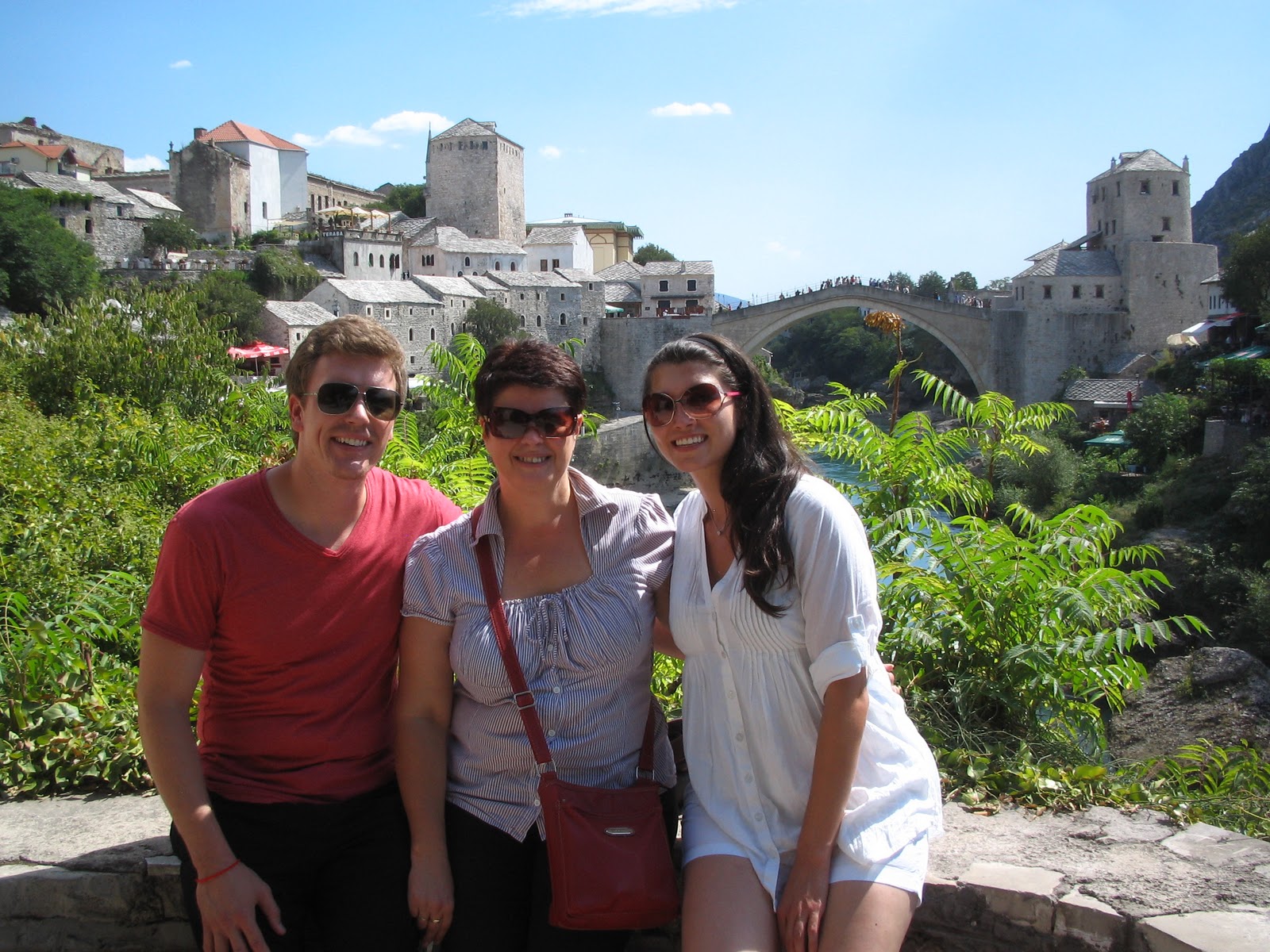
Shane, Alma and me in front of the Stari Most


The bridge being missiled to destruction in 1993
On a lighter note, there is an interesting tradition in Mostar.  Historically, the young men of the town, in order to impress the young ladies, would jump from the tip of the arch on the bridge, to the river below.  It doesn't seem so high from the picture, but once you get up there, you realize that it takes a great deal of courage to take the leap.  Nowadays, because of tourism, the jumpers will do this for money, so before a jump, they collect money from the watching audience.  Once they collect their goal, the jumper takes his leap...  


Thursday, October 13, 2011

Wine n Bike...

For one of our full day excursions in Dubrovnik, we found a Wine and Bike tour on the Peljesac peninsula through Culinary Croatia (http://www.culinary-croatia.com/wine-tours.html).  They also offer cooking classes, but Croatian food is known to be lacking, so I figured I didn't need cooking classes to learn how to prepare mediocre food (I can already do that on my own). 

Everyone we talked to about this excursion told us it sounded good in theory, but not so much in reality considering the logistics of drinking wine and then attempting to mountain bike.  After a minor setback in meeting up with our tour guide / winery owner, Mario, (we were waiting for him at the wrong gate outside the Old Town - who knew the "hole" we were waiting next to was not one of the 3 grand gates?), we were on our way to the Peljesac, a 1.5 hour drive from Dubrovnik.

On the way, Mario revealed that he had been a soldier for the Croatian army during the war.  He was about 35, but had experienced so much in that gruesome war.  "There were many unneccesary atrocities committed" he said, "many of my friends now suffer from PTSD".   

In addition to the war stories, he gave us a whole history lesson on the region during the drive, particularly what it was like living in a land that changed hands so many times throughout its history. He told us his 90 year old grandmother had 7 different passports from 7 different countries, but never left her little village.   Throughout the history lesson he sprinkled in the benefits of living a wine-filled lifestyle even commenting that his grandfather last drank water when he was 17!    

On the way to the Peljesac, Mario said, "I like this, no schedule. We can do whatever we want" as he pulled over to invite us for a cup of coffee in Ston. 
Ston was a major fort of the Ragusan Republic whose defensive walls were regarded as a notable feat of medieval architecture. The town's inner wall measures 890 metres in length, while the Great Wall outside the town has a circumference of 5 km.
According to Mario, the wall surrounding the city of Ston is second only to the Great Wall of China in terms of length and grandeur.  

Shorty after we finished our coffee, we stopped in to the Grgich Winery.  Per Wikipedia, "Mike Grgich (born Miljenko Grgić on April 1, 1923 in Desne) is a Croatian American winemaker in California.  He was born into a winemaking family in the town of Desne on Croatia's coastal region of Dalmatia. He is notable for being the winemaker behind the 1973 Chateau Montelena Chardonnay that bested several white Burgundy wines in the wine tasting event that became known as the Judgement of Paris. In recognition of his contributions to the wine industry, Grgich was inducted into the Culinary Institute of America's Vintner's Hall of Fame on March 7, 2008. The tribute comes at the same time that Grgich is celebrating his 50th vintage of winemaking in the Napa Valley."

Mario confirmed that story, and told us that thanks to Grgich, Croatian wine is on the map.  Grgich bought his winery in Croatia from the government after the war, as it used to be a fort.  The winery was in a beautiful setting, but inside it was 3rd world minimalist.  The wine was actually delicious.  There is something so earthy about Croatian wines, it's as if you can almost taste the soil. 


Grgich Winery
After completing our tour of the Grgich Winery and sampling some wines, we arrived in Mario's home / vinyard located in a 21 person village.  He pulled out the mountain bikes and we were on our way.  The Peljesac Peninsula is very mountainous, and the vineyards are planted on the side of the mountains.  This makes picking the ripe grapes a challenge, because it all has to be done by hand.  But, the resulting wine called Plavic Mali, is worth all the trouble. 


Now I know...never toss un-eaten grapes from a vine, much love, attention and passion are required to grow even the tiniest grapes...I think Mario nearly had a heart attack when I threw the remaining grapes onto the ground.


Mario's family had owned the land, and lived off of it, for 500 years.  The only reason that the government never seized their property throughout the various wars or the Socialist regime is because the government knew they could not maintain the vineyards or put the hard work it took in order to harvest the grapes. So land owners were allowed to keep their land, so long as they kept harvesting grapes.  The one caveat was that they could not produce their own wine, only the government was allowed.  Mario described how difficult it was to produce wine in the Peljesac in that time, particularly when there were no cars or roads going to the little villages. He had a phrase that he used that translated to, "no pride". It took a typical land owner 12 days to harvest all the grapes, so by the time he could complete the harvest, a great portion of the grapes would be spoiled. So, all neighbors from the various villages came up with a schedule to help out.  Cousins, friends and feuding neighbors all joined together with "no pride" and their donkeys in tow, to help harvest each others' grapes.  Small reservoirs (they looked like small, square, empty pools) were built in various villages, where all grapes from the entire region were stored.  Once the reservoir was full, the government would send their trucks to pick up the grapes and take them to the Cooperative Vineyard, where the government's wine would be produced.  The government to this day operates the Cooperative, and several land owners still sell their grapes to the government, but the Croatian wine has garnered so much recognition that the Cooperative can't compete with the wines produced by the land owners. 
Mario's love of wine was reflected in every word he spoke.  He told us that "wine is about the company and experience of drinking the wine over a meal, rather than the taste itself."  While true, I think he discredits how amazing Croation wine really is. 

The day ended beatifully with a typical Croatian meal prepared by Mario's sister, and more wine than we could drink! 


Thursday, October 6, 2011

Trip to Croatia

After much indecisiveness on where to go for our vacation, we settled on Croatia.  I had heard it was a beautiful country, and it was a place neither Shane nor I had been before.  We had no idea what to expect, so as soon as we booked our tickets, we started researching everything we could find in order to decide where to stay and what to do.  We bought Rick Steve's Slovenia and Croatia.  After reading through it, we decided to stay in Dubrovnik,  the "Pearl of the Adriatic", for the entire 6 days to get a good sense of the city.  The book was great to learn about the history, where to stay, restaurants, etc. but it didn't really have much in the way of activities.   Since we were staying 6 days, we wanted to have at least 2 full days of planned excursions.  More on the excursions later, but our itinerary looked like this:

Day 1 - Walk / Get lost in the Old Town
Day 2 - Beach
Day 3 - Excursion 1
Day 4 - Island Hopping
Day 5 - Excursion 2
Day 6 - Prepare to leave :(


There are approximately 1,200 islands off the coast of Croatia
Deciding where to stay in Dubrovnik was a challenge.  For one, it's a great deal more expensive than I thought it would be.  In addition, there are only a few hotels in the Old Town, the most well-known of which is Pucic Palace, but rates there were at around $500 per night.  So we decided to mix it up - stay a few nights in the Old Town, and a few nights in a resort by the beach.  If you want to stay in the Old Town and not pay exorbitant rates (unless you go ultra-lux), you need to find a sobe (essentially an apartment).  Many of the locals realized how profitable it is to lease out their apartments to foreigners during high season, so they moved out of the Old Town.  We were told that about 35,000 locals used to live in the Old Town, and since Old Town Dubrovnik became a tourist attraction, now only about 1,500 live there, and the rest just lease out their apartments. 

We called all the numbers in Rick Steve's book to find a place to stay.  Many were already booked, and others had minimum stays of longer than the 3 days we needed.  We ended up finding Dubrovnik Apartment Source http://www.dubrovnikapartmentsource.com/   They were great!  They have tons of gorgeous places to choose from, all vetted by the DAS team.  We even booked our taxi from the airport to the Old Town through the website.  Deciding on the resort was also difficult.  We deferred to TripAdvisor for that decision.  Among the top rated was Hotel Bellvue (http://www.hotel-bellevue.hr/Home.aspx?PageID=1&gohome=true)  Rates started at about $330/ night.  Personally, I didn't think it was worth it.  Even our "upgraded" room was quite bare.  There are no elevators to take you to your floor, so we had to lug around our huuuge suitcases down several flights of stairs.  Yes, I did say "down" stairs.  The reason is the hotel was built on the side of a cliff.  You walk in from the street level to the lobby, and all rooms are downstairs from there, wrapping around the side of the cliff. 

The Old Town of Dubronik is a picturesque, pedestrian area with beautiful, narrow streets surrounded by a wall 2 kilometers around. The bulk of the existing walls and fortifications was constructed during the 14th and 15th centuries but they were continually extended and strengthened up to and including the 17th century. The wall was built to protect this vulnerable city on the sea. 


A view of the Old City


Thursday, September 15, 2011

Favela Chic - London's Shoreditch Area

So, based on my last post, it is evident that we spent a lot of time in London's Shoreditch area.  This used to be one of the poorest neighborhoods in London, but many artists and musicians called it home.  When London's mainstream started catching on to the vibrant artsy scene in this area, many trendy bars, cafes and shops started popping up.  Since around 1996, Shoreditch has become a popular and fashionable part of London.  This area continues with the gentrification process, and many developers have already purchased blocks of old buildings to knock them down and erect high end hotels, among other developments.

In any case, during our stroll through the area, we stumbled into this really cute resto-bar / music venue called Favela Chic.  They've tried to re-create Brazil's favelas in Shoreditch by placing all sorts of found items throughout the place, and adding different colored light bulbs.  It all works somehow to give this place a good feeling.


After eating some of their delicious Pao de Queijo, we were getting ready to leave, but heard a sound check for a band that would be playing later on that night - Strangefruit.  We were instant fans! Their sound is inspired by Bob Dylan and Billie Holiday, and the lead singer's voice is so mesmerizing.  We ended up staying just to hear them...and I'm so happy we did! Check them out for yourselves....


My video (taken with a point and shoot camera) does not do them justice (but I really liked the song), so better yet, see their professional videos...


Tuesday, September 13, 2011

London Street Art Tour


We wanted to do something cultural in our time in London, but because both of us had been to London before, we didn't want to do the typical touristy spots such as the National Gallery or Buckingham Palace.  After doing a little research we came across the London Street Art Tour (http://streetartlondon.co.uk/tours/).  We booked through Expedia Activities and saved a few Pounds.

We had watched "Exit Through the Gift Shop" and were really excited about the possibility of seeing some of Banksy's art.  There was a mix up with our reservation, and the tour company was so accomodating, they set us up with a private tour, which was fantastic! Damien, our tour guide cum street artist was so knowlegable about each artist and the methods of producing the work.  We had seen some of the art in our own stroll through the area, but seeing it after hearing the story behind the artist and each artist's methods really provided a different perspective, and quite honestly, a greater appreciation for street art.   Here are some of our favorites:

Roa's art amazes.  He is a Belgian street artist that is renowned for his black and white animal street art.  We learned that he does all of his work free-hand with no stencils or grids (both of which are used by most street artists).  He chooses his subjects based on animals native to the particular region.  Roa's animals can be found in cities all across the world.

"Graffiti is one of the most free art expressions of the world; you don’t do it for money nor for an institution, it’s free expression and it liberates yourself creatively from a lot of restrictions"  - Roa


Stik was one of my favorites.  Stik was homeless for some time and was squatting in an abandoned building when he found some paint.  He started drawing stick figures (hence his alias) and realized how happy it made him.  Though his pieces are whimsical, many depict the lonliness he felt throughout his homeless period.  Now, Stik has become quite famous among the street artists and several galleries have made shows for him. He spends his time traveling the world tagging old buildings and new, with his stick figures and a great part of everyday ensuring no other graffiti artist has encroached on his works of art.  His story just goes to show that you never know what the world will bring you...

“Beauty is in movement. That’s what it’s about. Beauty is about the way that someone moves their body. You can tell by someone’s walk if they’re angry, whether they’re happy or if they’ve just eaten. You can tell a lot about someone just by the way they’re moving their back or their eyes. There doesn’t need to be a great deal of detail there. You can see it from across the road. You can see someone silhouetted against a white wall in the night and check whether they’re walking in an aggressive way or if they’re someone you know. That’s what I’m trying to capture in my work – that direct recognition” – Stik, in Little London Observationalist, 6 December 2009

"Surprising" describes Pablo Delgado's art.  We passed by some of his pieces without even noticing they were there, until Damien kneeled down to point them out. Delgado captures a scene in miniature, and it is such a surprise when you discover these little treasures.  It feels like uncovering a hidden secret.  The shadows painted on the concrete give the pieces such depth, that it kind of brings the viewer into the scene.  Apparently, among his favorite subjects are prostitutes, and of late, many street corners throughout London are sprinkled with tiny unnoticed prostitutes, casting shadows on the concrete sidewalks.

Unfortunately, Banksy's art eluded us.  We did see remnants of a few Banksy pieces, but most had been faded with time (which is apparently part of the beauty and mystique of street art, it is ethereal, and if you miss it, it may be gone forever).  Following the film's success, Banksy's pieces became so valuable that now the government is contemplating categorizing walls tagged by Banksy as pieces of historical heritage.  This will prevent developers (or the London Council) from destroying any more of Banksy's art.

We did see an old car painted pink by Banksy. The car (much like most remaining Banksy paintings), is now covered entirely in plexiglass to help preserve it.

Sunday, September 11, 2011

The Pale Blue Door

Last Saturday was our 1 year anniversary.  By pure coincidence and lots of luck, we were going to be in London on that day.  I made Shane in charge of planning something "memorable".  When he told me he had made reservations, I responded with "I hope it's not JUST dinner".  Unfortunately for Shane, he had just made dinner reservations at a nice restaurant.  So, he went back to the drawing board with a challenge.  He was determined to find not just a restaurant, but an experience.  After much research he came across the Pale Blue Door, which, lucky for us, would be in town through that Sunday.  The Pale Blue Door is a new type of dining experience that's popping up all over the world. It's a "pop-up-diner".  This particular place was designed by Tony Hornecker, a set designer who's worked on sets for the likes of Lady Gaga among others.  He started this dining experience in his Shoreditch area flat as a way to pay the mortgage.  Now, Tony has re-created this experience in different cities all over the world.  I would post the address, but, Tony gets it to you only after making the initial deposit.

While the food was nothing to write home about, the entire experience was definitely memorable, and if in a city where the diner pops up (and you're open minded) then I highly recommend you make reservations.

Knocking on the Pale Blue Door

 The place is called the Pale Blue Door because that is the only consistent item that travels with Tony to the different cities.  The rest of the space is decorated by items found by Tony and team in the particular city where the restaurant experience is popping up, and remnants of Tony's sets.

When you arrive, you are greeted by the hostess and entertainment for the evening, Ms. A Man to Pet...


You are encouraged to walk around the place to check out all of the interesting nooks and crannies, and random items that make up the quirky decor.  And let me tell you, they are certainly interesting.  You can walk up and down staircases that wind around the space and have to actually crawl into several of the dining areas. Below is a picture of one of the dining spots.  We had to go up winding stairs, crawl through a small tunnel and ultimately arrive here, where the utensils and plate set were set out on the bed.


Things got wilder as the night progressed...Ms. A Man to Pet is an amazing DJ that knows how to heat things up.


We shared many laughs and definitely had a memorable experience.  Here's a little preview of Ms. A Man to Pet's talents....


For details on reservations go to: http://tonyhornecker.wordpress.com/